
What is GHRP-6?
GHRP-6 (Growth Hormone Releasing Peptide-6) is a synthetic hexapeptide that stimulates growth hormone (GH) release from the pituitary gland. Developed in the 1980s, GHRP-6 was among the first peptides discovered to act on the growth hormone secretagogue receptor (GHS-R), now known as the ghrelin receptor.
Unlike growth hormone releasing hormone (GHRH), which amplifies GH pulses, GHRP-6 initiates GH release through a distinct pathway, making it a valuable tool for growth hormone research.
Understanding Growth Hormone Secretagogues
The GHS-R/Ghrelin System
GHRP-6 acts on the growth hormone secretagogue receptor:
GHS-R1a (Ghrelin Receptor):
GHRP-6 vs Ghrelin:
| Property | GHRP-6 | Ghrelin |
|---|---|---|
| Origin | Synthetic hexapeptide | Endogenous hormone |
| Amino Acids | 6 | 28 |
| Discovery | 1984 | 1999 |
| Receptor | GHS-R1a | GHS-R1a |
| Half-life | ~20-30 minutes | ~15-20 minutes |
GHRP-6 actually predates the discovery of ghrelin, its natural ligand.
GHRH vs GHRP Pathways
GHRH (Growth Hormone Releasing Hormone):
GHRP (Growth Hormone Releasing Peptides):
Synergy:
GHRH and GHRPs work through different mechanisms, potentially producing synergistic GH release when combined.
Mechanism of Action
Pituitary Effects
GH Release Pathway:
Hypothalamic Effects
GHRP-6 also acts centrally:
Unique GHRP-6 Characteristics
Appetite Stimulation:
Cortisol and Prolactin:
Peptide Profile
| Property | Details |
|---|---|
| Full Name | Growth Hormone Releasing Peptide-6 |
| Sequence | His-D-Trp-Ala-Trp-D-Phe-Lys-NH2 |
| Amino Acids | 6 (hexapeptide) |
| Molecular Weight | 873.01 g/mol |
| Purity | 99%+ (HPLC verified) |
| Form | Lyophilized powder |
| Solubility | Water, bacteriostatic water |
GHRP Comparison
GHRP-6 vs GHRP-2 vs Ipamorelin
| Feature | GHRP-6 | GHRP-2 | Ipamorelin |
|---|---|---|---|
| GH Release | Strong | Strongest | Moderate |
| Appetite Increase | Strong | Moderate | Minimal |
| Cortisol Effect | Mild | Moderate | Minimal |
| Prolactin Effect | Mild | Moderate | Minimal |
| Selectivity | Lower | Lower | Higher |
Choosing a GHRP:
See our Ipamorelin guide for comparison.
GHRP-6 + CJC-1295 Combination
Research often examines GHRP/GHRH analog combinations:
Rationale:
CJC-1295 Options:
Research Applications
Growth Hormone Studies
GH Axis Research:
Metabolic Research:
Appetite Research
Ghrelin System:
GHRP-6's strong appetite effects make it useful for hunger/satiety research.
Comparative Studies
Peptide Comparisons:
Dosage Protocols in Research
Reconstitution
GHRP-6 requires reconstitution from lyophilized form:
Standard Protocol:
| Vial Size | Bacteriostatic Water | Concentration |
|---|---|---|
| 5mg | 2ml | 2.5mg/ml (2500mcg/ml) |
| 5mg | 2.5ml | 2mg/ml (2000mcg/ml) |
Procedure:
Use our peptide calculator for accurate measurements.
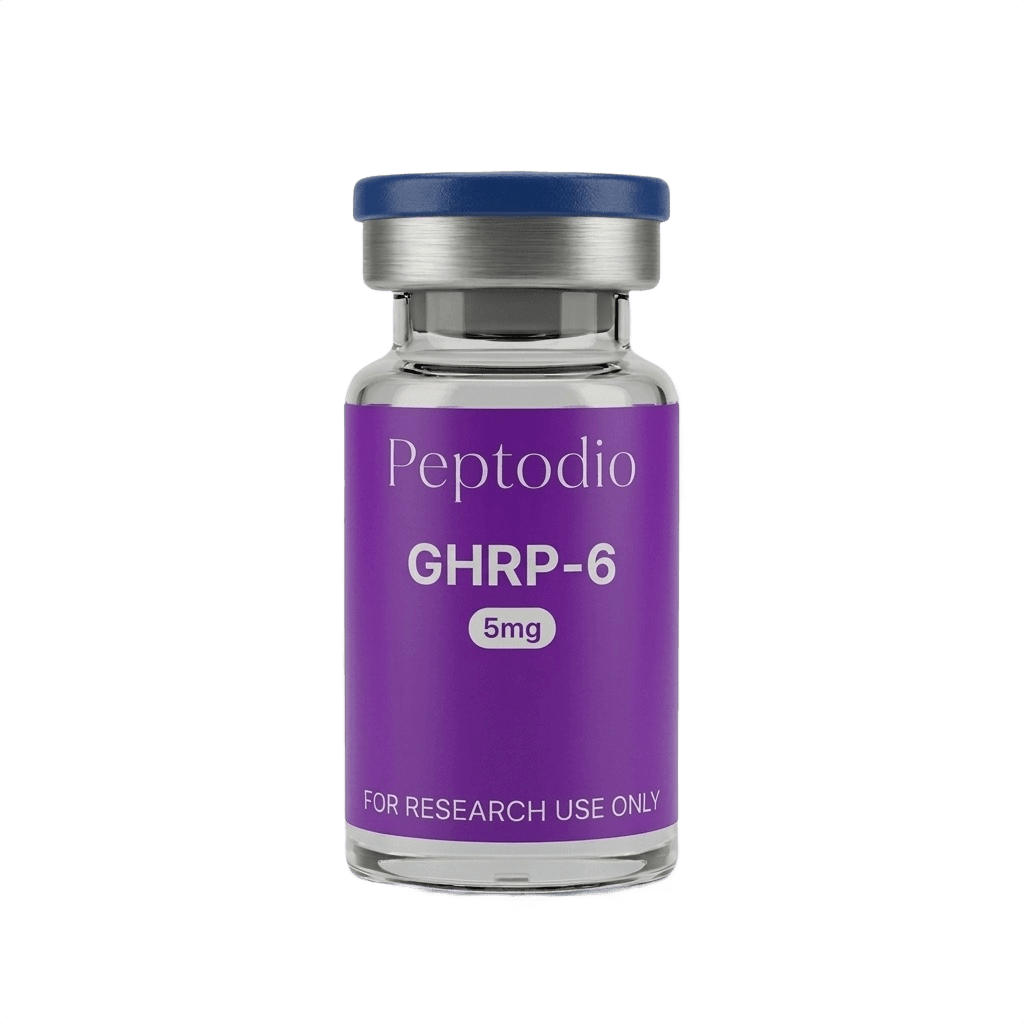
GHRP-6
5mg • 99%+ Purity
$19.99
In Stock
Research Dosing Ranges
Literature References:
Timing Considerations:
Combination Protocols
GHRP-6 + GHRH Analog:
Storage Guidelines
Lyophilized Form
Optimal Storage:
Reconstituted Solution
Requirements:
See our storage guide.
Safety Profile in Research
Documented Effects
Common Observations:
Hormonal Effects:
Research Considerations
Regulatory Status
Understanding GH Response
Factors Affecting GH Release
Enhanced Response:
Diminished Response:
Measuring GH Response
Research typically measures:
Frequently Asked Questions
What is the difference between GHRP-6 and GHRP-2?
Both are growth hormone releasing peptides acting on the ghrelin receptor. GHRP-2 produces slightly stronger GH release but also greater cortisol and prolactin elevation. GHRP-6 has more pronounced appetite-stimulating effects. Ipamorelin is more selective with minimal side effects.
Why does GHRP-6 increase appetite?
GHRP-6 strongly activates the ghrelin receptor (GHS-R1a), the same receptor that responds to ghrelin—the "hunger hormone." This is an intrinsic property of GHS-R agonism. GHRP-6 has more pronounced appetite effects than GHRP-2 or Ipamorelin.
Can GHRP-6 be combined with CJC-1295?
Yes, this is a common research combination. GHRP-6 acts on the ghrelin receptor to initiate GH release, while CJC-1295 (GHRH analog) acts on GHRH receptors to amplify the pulse. The different mechanisms may produce synergistic effects.
What is the optimal timing for GHRP-6?
GH release is typically studied in the fasted state, as food (especially fats) can blunt the response. GH peaks approximately 15-30 minutes after administration. Multiple daily doses are often studied to mimic pulsatile release patterns.
Does GHRP-6 have side effects?
Research has documented hunger increase (prominent), transient flushing, mild water retention, and slight cortisol/prolactin elevation. The appetite effect is more pronounced than other GHRPs. These effects are generally transient and dose-dependent.
How should GHRP-6 be stored?
Lyophilized GHRP-6 should be stored at -20°C for maximum stability. Once reconstituted with bacteriostatic water, store at 2-8°C and use within 4-6 weeks. Protect from light and never freeze reconstituted solution.
Related Resources
Conclusion
GHRP-6 remains a foundational tool in growth hormone research, providing direct insight into pituitary GH release mechanisms. Its discovery predated—and led to—the identification of ghrelin and the GHS-R system, illustrating how synthetic peptides can illuminate endogenous biology.
For researchers studying the GH axis, appetite regulation, or GHRP pharmacology, GHRP-6 offers well-characterized effects with extensive literature support.
Use our calculator for research preparation.
Related Growth Hormone Peptides
View All
This article is for informational purposes only. GHRP-6 is sold for research purposes and is not intended for human consumption. All research should be conducted in accordance with applicable regulations.