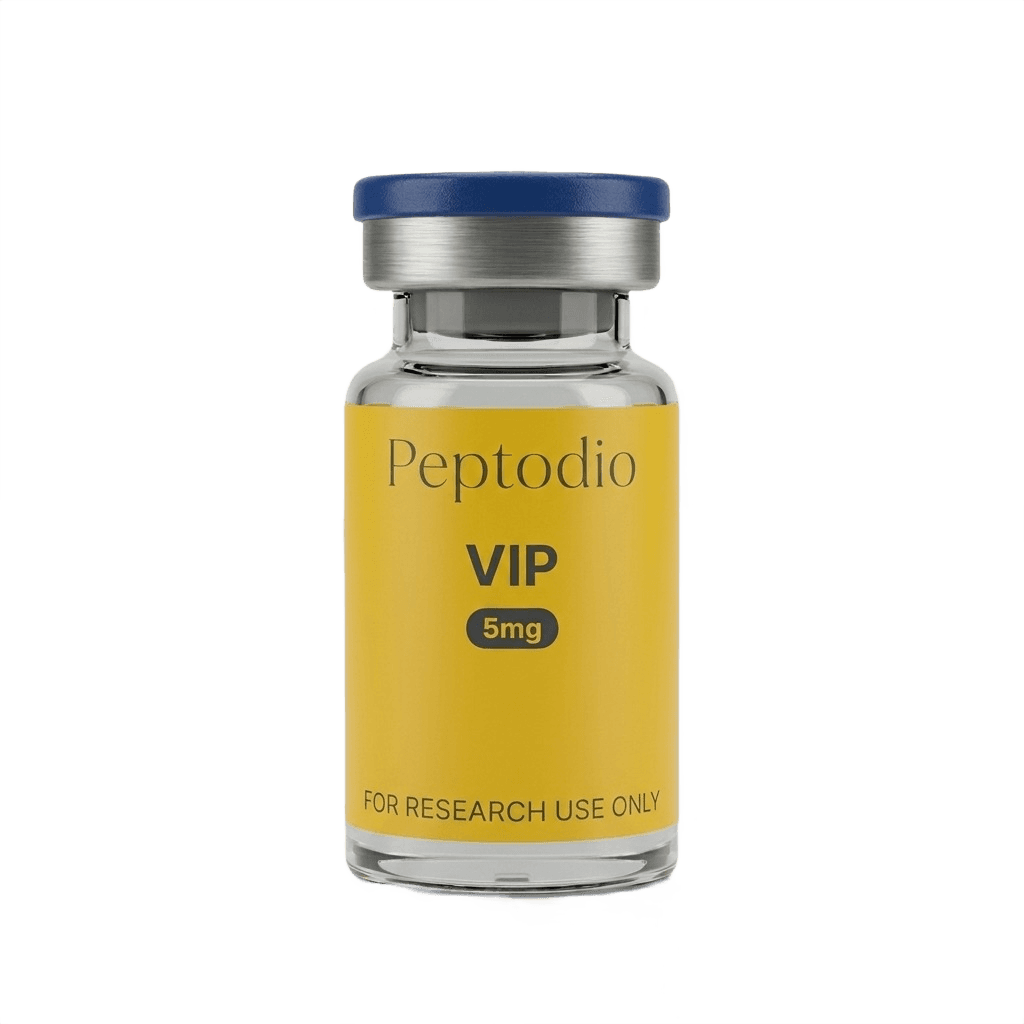
VIP
5mg · 99%+ Purity
HPLC Tested
99%+ Purity
About Our Testing
Every batch is tested by our manufacturer using HPLC analysis. Per-batch third-party testing adds significant cost and delays that would be passed to customers.
Fast Shipping
Same-day dispatch
Description
VIP (Vasoactive Intestinal Peptide) is investigated for its immunomodulatory role and influence on gut motility. Research explores its potential in mucosal protection and maintaining intestinal health models.
Research Use Only: This product is intended for laboratory research purposes only. Not for human consumption.
Research & Science
Evidence-based information about this compound
Chemical Properties
CAS Number
37221-79-7
Molecular Formula
C147H237N43O43S
Molecular Weight
3326.83 g/mol
Amino Acid Sequence
His-Ser-Asp-Ala-Val-Phe-Thr-Asp-Asn-Tyr-Thr-Arg-Leu-Arg-Lys-Gln-Met-Ala-Val-Lys-Lys-Tyr-Leu-Asn-Ser-Ile-Leu-Asn-NH2
Also known as:
Vasoactive Intestinal Polypeptide, VIP Peptide
Vasoactive Intestinal Peptide (VIP) is a 28-amino acid neuropeptide that was first isolated from porcine small intestine but is now known to be widely distributed throughout the body. It belongs to the secretin-glucagon family of peptides and acts as both a neurotransmitter and a hormone.
VIP is found in the central and peripheral nervous systems, the gastrointestinal tract, the respiratory system, and immune tissues. It signals through two G-protein coupled receptors, VPAC1 and VPAC2, which are distributed throughout the body.
This peptide has diverse physiological functions including vasodilation, neuromodulation, immune regulation, and circadian rhythm control, making it relevant to multiple areas of research.
VIP acts through specific receptor pathways:
- Receptor Binding: Activates VPAC1 and VPAC2 G-protein coupled receptors.
- cAMP Signaling: Receptor activation increases intracellular cAMP.
- Vasodilation: Causes relaxation of vascular smooth muscle.
- Neuromodulation: Acts as a neurotransmitter in central and peripheral neurons.
- Immune Modulation: Influences immune cell function and cytokine production.
VIP has documented neuroprotective effects:
- Neuronal Survival: Promotes survival of neurons under stress conditions.
- Anti-Inflammatory: Reduces neuroinflammation in various models.
- Glial Function: Modulates glial cell activity and cytokine release.
- Memory: May influence memory and cognitive processes.
These effects make VIP relevant to neurodegenerative disease research.
Sources:
VIP has significant immunomodulatory effects:
- Anti-Inflammatory: Reduces production of pro-inflammatory cytokines.
- Autoimmunity: Shows benefit in autoimmune disease models.
- Regulatory T Cells: May promote regulatory T cell development.
- Macrophage Function: Modulates macrophage activation.
VIP's immune effects have therapeutic research applications.
Sources:
This information is provided for educational purposes only and is based on published scientific research. This product is intended for research use only.